| ← Chapter 10 | Index |
1. Adding a cycle
inductive CyclicArrow where
  | alpha : CyclicArrow   -- 0 → 1
  | beta : CyclicArrow     -- 1 → 2
  | gamma : CyclicArrow    -- 2 → 0

def cyclicQuiver : Quiver (Fin 3) CyclicArrow where
  source := fun a => match a with
    | CyclicArrow.alpha => 0
    | CyclicArrow.beta => 1
    | CyclicArrow.gamma => 2
  target := fun a => match a with
    | CyclicArrow.alpha => 1
    | CyclicArrow.beta => 2
    | CyclicArrow.gamma => 0

def cPathAlpha : Path cyclicQuiver 0 1 :=
  Path.cons CyclicArrow.alpha rfl rfl (Path.nil 0)

def cPathBetaAlpha : Path cyclicQuiver 0 2 :=
  Path.cons CyclicArrow.beta rfl rfl cPathAlpha

def cPathGammaBetaAlpha : Path cyclicQuiver 0 0 :=
  Path.cons CyclicArrow.gamma rfl rfl cPathBetaAlpha
Each rfl again discharges a source/target proof obligation that reduces,
by definition, from the match in cyclicQuiver. Observe that
cPathGammaBetaAlpha is a nontrivial loop at vertex 0. The path
algebra of a quiver with cycles has elements of arbitrarily high “length,”
which is exactly why such algebras are usually infinite-dimensional unless
relations (an “admissible ideal”) are imposed on the path algebra.
2. theorem append_nil_left
theorem append_nil_left {V A : Type} {Q : Quiver V A} {u v : V} (p : Path Q u v) :
    Path.append (Path.nil u) p = p := by
  induction p with
  | nil =>
    -- Goal: Path.append (Path.nil u) (Path.nil u) = Path.nil u
    -- (`nil`'s case binds no fresh variable here — the vertex is already
    -- fixed by p's own type — so there is nothing to name.)
    -- Path.append unfolds on its second argument being `nil`, giving
    -- `Path.nil u` on the nose.
    rfl
  | cons a h h' q' ih =>
    -- ih : Path.append (Path.nil u) q' = q'
    -- Goal: Path.append (Path.nil u) (Path.cons a h h' q') = Path.cons a h h' q'
    show Path.cons a h h' (Path.append (Path.nil u) q') = Path.cons a h h' q'
    rw [ih]
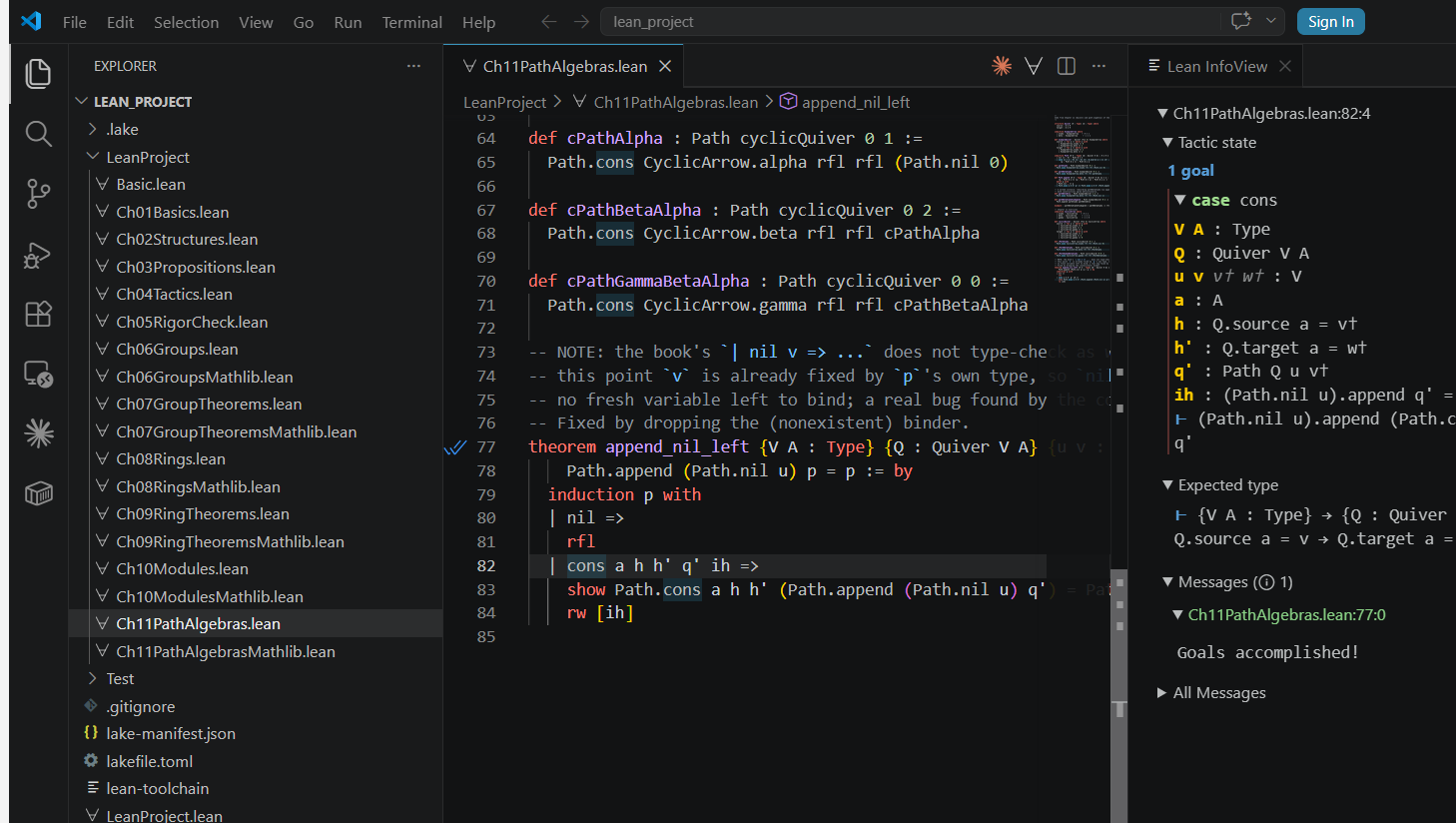
This is exactly what the editor shows in the cons case: the Lean
Infoview lists every hypothesis the pattern match introduces —
Q : Quiver V A, h : Q.source a = v, h' : Q.target a = wt,
q' : Path Q u vt, and the induction hypothesis
ih : (Path.nil u).append q' = q' — above the line, with the goal
(Path.nil u).append (Path.cons a h h' q') = Path.cons a h h' q' below
it:
This mirrors Path.append’s own recursion, case for case. Path.append
was defined by matching on its second argument, so induction p (which
splits into cases on exactly that argument, generating the matching
induction hypothesis ih in the cons case) unfolds the definition
directly. In the nil case, both sides are Path.nil u by definition. In
the cons case, unfolding Path.append’s defining equation turns the goal
into Path.cons a h h' (Path.append (Path.nil u) q') = Path.cons a h h' q'
(the show line makes this explicit rather than leaving it to
elaboration), and rw [ih] completes the proof using the induction
hypothesis.
3. Sketch of PathAlgebra
-- A k-linear combination of paths from u to v, as a finitely-supported
-- function from paths to coefficients. `Finsupp`-style support tracking is
-- the honest way to do this; a simplified sketch:
structure PathAlgebraElem (V A : Type) (Q : Quiver V A) (k : Type) where
  -- coeff p = the coefficient of path p, for finitely many nonzero p
  coeff : {u v : V} → Path Q u v → k
  -- (a finiteness/support condition would be required here in a full
  -- development, e.g. via Mathlib's `Finsupp`)

-- To satisfy `Ring` (Chapter 8), `PathAlgebraElem` would need:
--   addGrp : CommGroup (PathAlgebraElem V A Q k)   -- pointwise addition of coefficients
--   mul    : concatenate paths, multiplying and summing coefficients over
--            all ways two paths compose (zero when endpoints don't match)
--   one    : the sum, over all vertices v, of 1 · (trivial path at v)
--            (an idempotent identity, since Q may have infinitely many
--            vertices this "one" is only literally an element when Q0 is
--            finite — for infinite Q the path algebra is typically only
--            a "ring with local units," a subtlety Mathlib's category-
--            theoretic treatment handles more gracefully than a bare Ring)
The real finiteness/support bookkeeping (tracking which paths have nonzero
coefficient) is exactly what makes a full formalization a genuine project
rather than a one-page exercise. This sketch identifies the three Ring
fields that require it (addGrp, mul, one), and shows why one is the
subtle one when $Q_0$ is infinite.
Checkpoint project: path length, and composition respects it
def Path.length {V A : Type} {Q : Quiver V A} : {u v : V} → Path Q u v → Nat
  | _, _, Path.nil _ => 0
  | _, _, Path.cons _ _ _ p => p.length + 1

theorem Path.append_length {V A : Type} {Q : Quiver V A} {u v w : V}
    (p : Path Q u v) (q : Path Q v w) :
    (Path.append p q).length = p.length + q.length := by
  induction q with
  | nil =>
    simp only [Path.append, Path.length]
    rw [Nat.add_zero]
  | cons a h h' q' ih =>
    simp only [Path.append, Path.length]
    rw [ih, Nat.add_assoc]

example : (Path.append pathAlpha pathBetaOnly).length =
    pathAlpha.length + pathBetaOnly.length :=
  Path.append_length pathAlpha pathBetaOnly

#eval pathAlpha.length                                    -- 1
#eval pathBetaAlpha.length                                -- 2
#eval (Path.append pathAlpha pathBetaOnly).length          -- 2
Neither Path.append nor Path.length can be watched with dbg_trace
in isolation: a bare Path has no Repr instance, so only the composed
.length call ever produces something #eval can print. Tracing both at
once shows Path.append finish building the whole composed path first,
then Path.length walk it afterward — the two recursions do not
interleave:
def Path.append' {V A : Type} {Q : Quiver V A} {u v w : V}
    (p : Path Q u v) (q : Path Q v w) : Path Q u w :=
  match q with
  | Path.nil _ => dbg_trace s!"append: q is nil, base case, returning p unchanged"; p
  | Path.cons a h h' q' =>
      dbg_trace s!"append: q ends with an arrow, recursing on the shorter path underneath, then re-attaching that arrow";
      Path.cons a h h' (Path.append' p q')

def Path.length' {V A : Type} {Q : Quiver V A} : {u v : V} → Path Q u v → Nat
  | _, _, Path.nil _ => dbg_trace s!"length: nil, base case, returning 0"; 0
  | _, _, Path.cons _ _ _ p => dbg_trace s!"length: cons, adding 1 to the rest's length"; p.length' + 1

#eval (Path.append' pathAlpha pathBetaOnly).length'
-- append: q ends with an arrow, recursing on the shorter path underneath, then re-attaching that arrow
-- append: q is nil, base case, returning p unchanged
-- length: cons, adding 1 to the rest's length
-- length: cons, adding 1 to the rest's length
-- length: nil, base case, returning 0
-- 2
Path.length recurses on the same two constructors as Path.append
itself (Sections 4–5): nil contributes 0, and each cons adds one to the
length of the shorter path it extends. The proof of append_length
mirrors Path.append’s own recursion case for case, exactly as the
project asked, but with one genuine surprise if rfl is tried first in
either case: it fails. Path is indexed by both endpoints. Because of
this, Lean compiles a match on an indexed family so that its defining
equations reduce only through their auto-generated equation lemmas, not
through plain iota-reduction, once an abstract path (p, q') is
involved. Concrete, fully closed paths like pathAlpha still reduce fine
under #eval — that is why the three checks above work directly. But the
general, universally-quantified theorem does not close by rfl.
simp only [Path.append, Path.length] names exactly the two
definitions being unfolded and nothing else, so it plays the same explicit
role a rw would if these equations were reachable that way — it is not
standing in for an unknown pile of simp lemmas, only for the two named
here. This is the same kind of real, verified obstacle Chapter 6, Section 4’s
Perm3.ext ran into with core Lean’s lack of a structure
extensionality lemma, now met again with indexed recursion instead.
| ← Chapter 10 | Index | Table of contents |